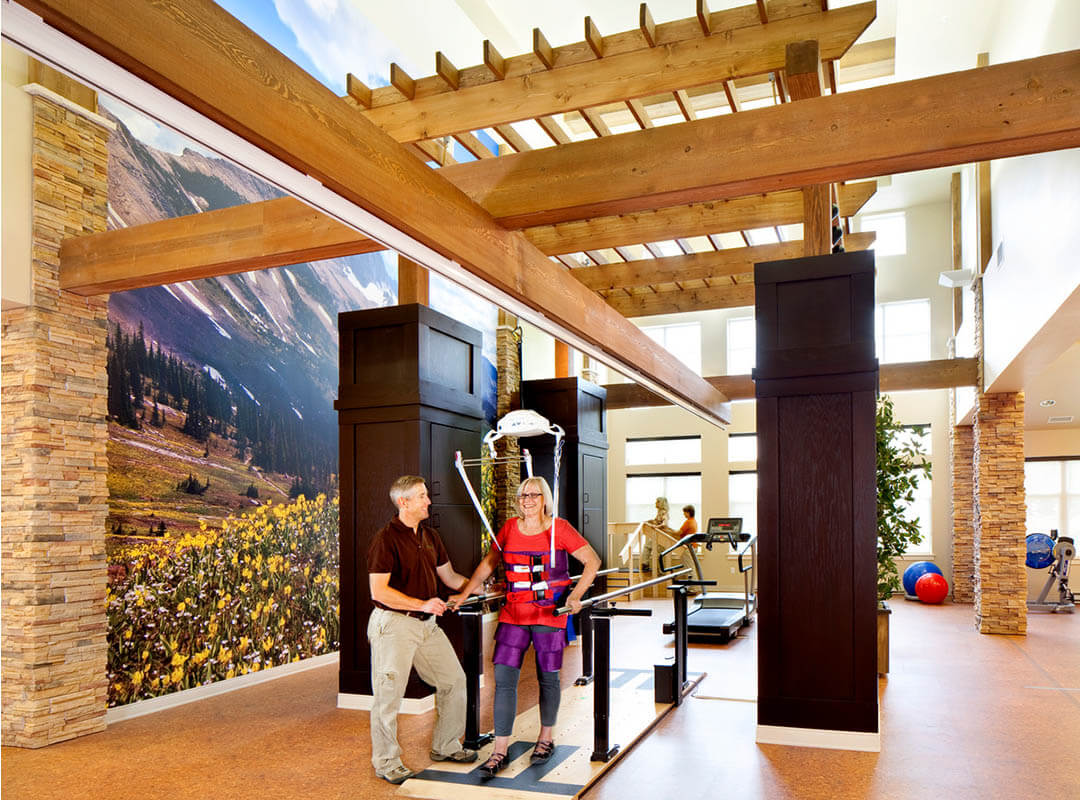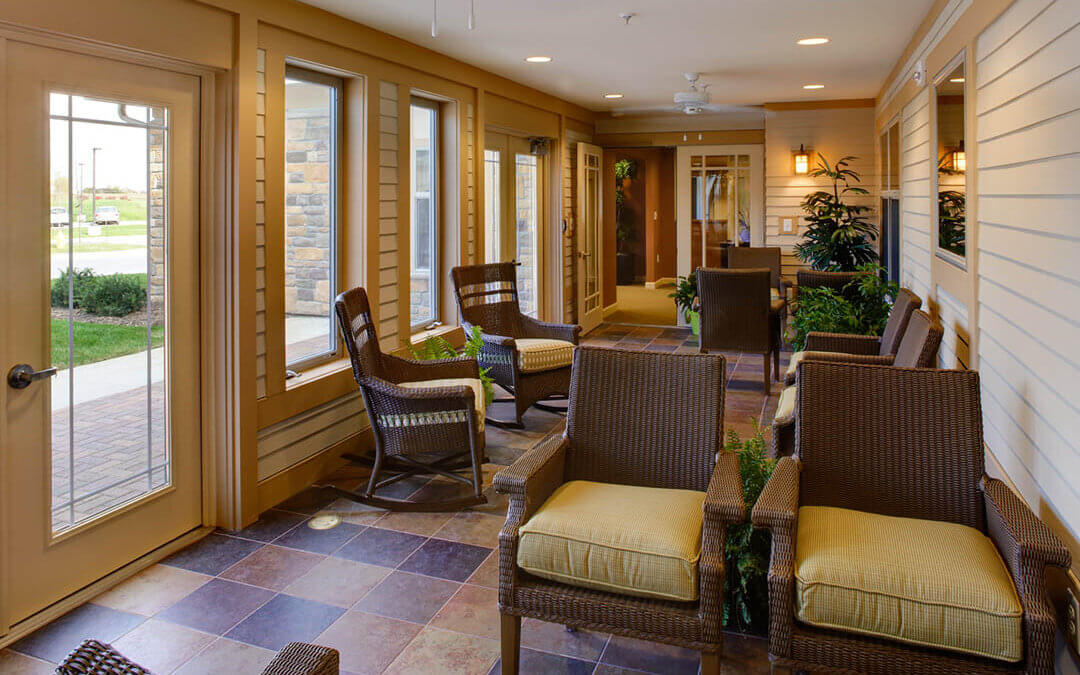
Senior living communities are constantly evolving and searching for ways to improve the experience for residents, families, and staff. A key factor in elevating the senior living experience is providing residents with deep and meaningful connections to the outdoors and enhanced socialization. This aligns with a growing design industry focus on biophilia—”the innate human instinct to connect with nature and other living beings.” Biophilic design elements promote a healthy, comfortable, and engaging environment.
The successful integration of biophilic concepts is more than adding plants to the interior. It requires the thoughtful contemplation of numerous design factors and an understanding of daily operations. The application of design ideas starts during the preliminary site master planning discussions and continues until the last piece of artwork is hung in the finished building and the owner occupies the space. Understanding daily resident life, including care needs, routines, paths of travel, and social activities, influences design decisions and maximizes the positive impact on everyone who enters the community.

Biophilic Basics
When it comes to adopting a biophilic mindset for life at senior living communities, AG Senior Associate Andrew Alden advises focusing on the fundamental principles of the design concept—”increasing building users’ connections to the natural world.” When questioning how to do that, he says, “by highlighting the connection with the outdoors and bringing the outdoors inside the building through actual natural elements and representational versions.”
Alden has joined forces with colleagues Lisa Warnock, principal of Thoma-Holec Design; Clare Hahneman, senior business development manager of Ecumen; Grant Thompson, an associate at Genus Landscape Architects; and Joe Sweitzer, senior project manager of Navigate Building Solutions to share insights on biophilic design at industry conferences. They have been working together to implement biophilic design principles in several assisted living and memory care communities for Nelson Development & Construction.
The team explains how the Biophilic Design Philosophy is generally organized into three categories.
- Nature in the Space: Establishing interior and exterior visual connections with living natural elements such as plants, trees, water features, etc.
- Nature of the Space: Creating imitations of natural processes, such as tunable lighting based on circadian rhythms. This can also include the physical shape of a space and its experience, like the soaring understory of a canopy of trees represented in the heavy timbers of a cathedral ceiling in a formal dining area.
- Nature Analogues: Representing natural elements through color, pattern, texture, etc. This is also referred to as biomimicry.
[Reference – Kellert, S.R.; Heerwagen, J.; Mador, M. Biophilic Design: The Theory, Science, and Practice of Bringing Buildings to Life; Wiley & Sons: New York, NY, USA; Hoboken, NJ, USA, 2008.]
See it is more than plants! And there is research to support the advantages of designing with a biophilic mindset. Numerous studies cite the advantages of even minimal exposure to the natural world, often referred to as “micro-doses”. The positive impact even extends to Virtual Reality. When older adults experience VR immersion in a natural setting, they show significant improvements in “good” mood and “calm” mood dimensions.
[Reference – Saleh Kalantari, PhD, Tong Bill Xu, MS, Armin Mostafavi, MS, Angella Lee, Ruth Barankevich, MS, Walter R Boot, PhD, Sara J Czaja, PhD, Using a Nature-Based Virtual Reality Environment for Improving Mood States and Cognitive Engagement in Older Adults: A Mixed-Method Feasibility Study, Innovation in Aging, Volume 6, Issue 3, 1-17, 2022]
If you want to elevate your community with deeper connections to nature, here are a few architecture-focused details to consider.
Site & Building Considerations
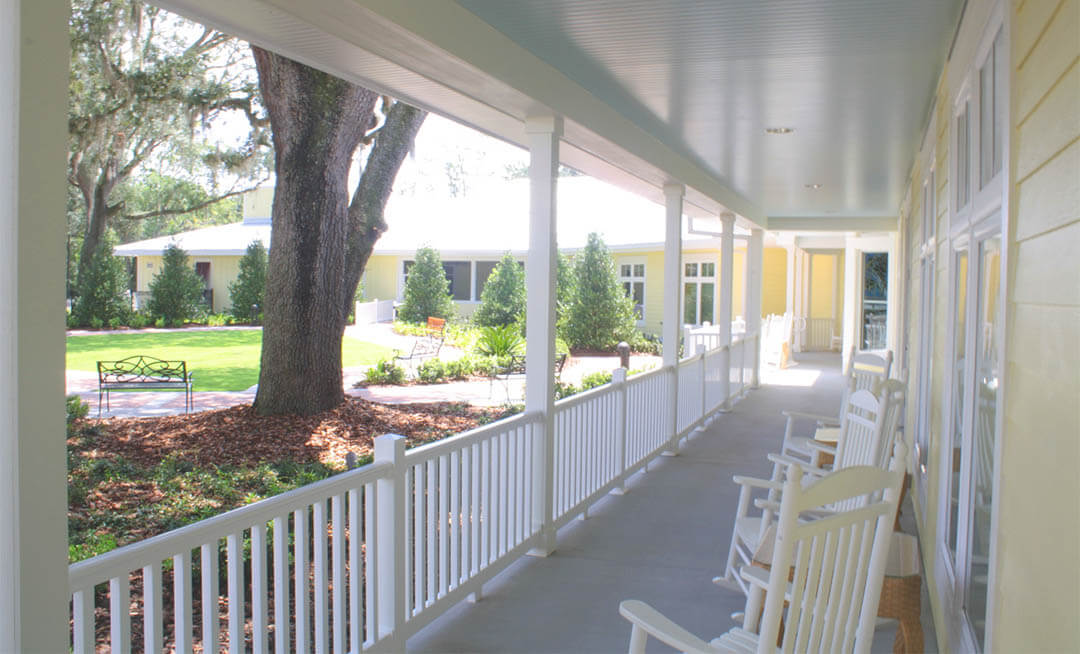
According to Alden, biophilic design from an architectural perspective is based on three components—the site, the edge of engagement, and the building. The master planning process looks at ways to maximize the site and building placement. Taking advantage of natural elements is a typical practice but a biophilic design focus reinforces the “Nature in the Space” perspective. The design team thinks about how the buildings interact with the land and natural features, thoroughly evaluates the orientation and views being created from the building, and considers how the placement can create enticing exterior gardens and gathering spaces.
“When you have great trees, a lake, or mountainous surroundings, the positioning of the buildings will make all the difference in the interior experience,” says Alden. “Not every project is lucky enough to have access to existing natural features, sometimes teams need to design and implement their own.”
Addressing “Edge of Engagement” refers to how the team shapes both the interior and exterior experience at the building envelope as well as providing people with options for how and when they engage with the outdoors.
This includes addressing physical comfort by providing a way to help modify the amount of sun exposure and control thermal comfort levels. This may include operable windows, ceiling fans, and appropriate window coverings for people inside. And for those outside, a covered porch may be provided with ceiling fans, other shading options such as pergolas or umbrellas address comfort, or if you are in a colder climate, radiant heaters can be included.
Offering choices for different levels of engagement means residents can choose to watch, get hands-on, or a little bit of both. For example, the design may allow for residents to sit inside while people-watching outside or observe a bird feeder, butterflies, etc. Or they can sit outside under shade to passively watch. Others may choose to be outside actively gardening, playing a game, or strolling on a path. Sometimes if an opportunity for an edge of engagement does not exist, you can transform an interior space through biomimicry.
A priority throughout the architectural design development is maximizing daylight. The site and building considerations are driven by creating access to ample and controllable natural light. This supports the space planning process. The daylight experience in every resident room and amenity space is taken into consideration and adjacencies and design details are considered to find ways to bring natural light into as many areas of the building as possible.
A strong partnership between architecture and interiors supports strong indoor/outdoor connections. By thoughtfully placing the building on the site and then carefully locating the most commonly used amenities, the team ensures maximum exposure to natural light and the best views of nature. This partnership also impacts other important biophilic design priorities such as supporting clean, toxin-free air and mimicking the sounds, light, and patterns of nature.
A Team Effort
When biophilic goals are established for a project, architecture, interior design, landscape design and construction are all key components, but it is the operational commitment that determines the success.
With every design decision, there is an operational consideration. That is why the team needs to establish an overall biophilic design strategy with clear goals. When making decisions the team can weigh the design impact against the initial project costs and long-term budget implications.
Interested in learning more about how biophilic design can elevate the senior living experience? Stay tuned for the release of an AG Insights Report that shares the construction, landscape design, interior design, and operations perspectives. It will include best practices, project examples, and a list of resources. Contact AG’s Andrew Alden – aalden@agarch.com to receive a report directly when it is available.