
Thinking about capital improvements? Is it time to make facility upgrades and modernizations? Look beyond the obvious finishes and furnishings and focus on comfort, health and energy efficiency to keep residents and staff satisfied.
There are many existing senior living buildings in operation that were constructed more than twenty years ago when mechanical and energy codes were very different from current versions. Construction methods tightened structures to become more energy efficient, and buildings got ‘sick’ as indoor air quality went down. The response was to mechanically add some outdoor air back into the building. As the quantity of outdoor air required increased, the HVAC systems became more complicated and oftentimes were trying to do too much with too little equipment.
The Real First Impression
Walk into any building and if you really think about it, the first and most impactful impression is the air quality. A damp, clammy, musty feeling and strong presence of odors will quickly overshadow any efforts to make a space look inviting. HVAC systems are difficult to design and operate because their nature is to be constantly changing. The temperature changes all day as the sun moves across the sky. Weather patterns can bring wild fluctuations in outside temperature over the span of a single day, then consider the impact of annual seasonal conditions. Add some humidity and rain to the mix. Now we should also consider aerosolized particles in the airstream from viruses—and possibly wildfire smoke. All of that adds up to a lot for any one system to manage and maintain a comfortable indoor environment. Many have tried, and few have succeeded. This is where a DOAS, or Dedicated Outdoor Air System, is crucial to maintain operational goals.
The Benefits of DOAS
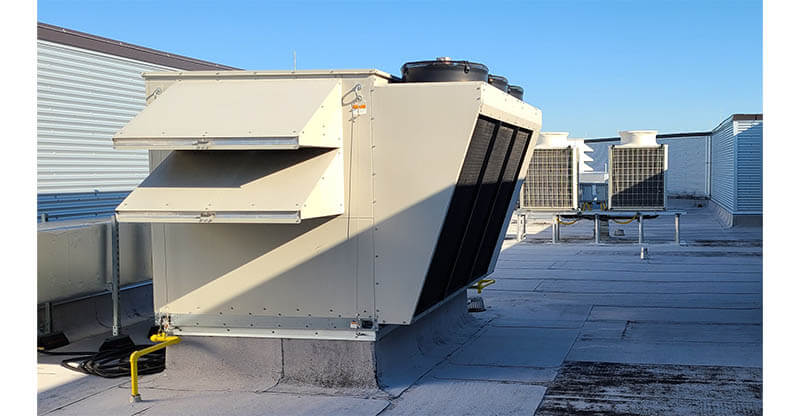
A DOAS unit is typically a specialized rooftop air handling unit. It may deliver 100% of its airflow as outdoor air. This is significantly more than a conventional RTU rooftop unit’s 25-30% outdoor air limit to protect the equipment from damage at extreme temperatures. DOAS units are more robustly constructed. The cooling coils are much larger to provide more surface for condensation to dehumidify. Multiple compressors allow for a greater degree of staging and matching the system capacity to load conditions for more efficient run times.
Adding a DOAS unit separates the task of ventilating from the temperature control system. An existing HVAC system, assuming it has the capacity to heat and cool a building, doesn’t have to change. The DOAS system ductwork can distribute air directly to the occupied spaces without interfering with the temperature control system by providing “neutral air”. This is air at approximately 70 degrees F and 50% relative humidity. This can be supplied year-round, winter or summer without changing the setpoint. The system will utilize any combination of the following to get the discharge air to a neutral point:
- Natural gas-fired heating
- Central plant hot water heating
- Dx cooling
- Dx cooling with electric or hot gas reheat to dehumidify
- Energy recovery for precooling/preheating incoming air

Overcoming Challenges
The biggest challenge is finding space for this added ductwork. Most buildings that do not include mechanical ventilation have tighter ceiling spaces and lower floor-to-floor heights. Instead of extending new ductwork to every space, the DOAS can feed into other existing air handling equipment and use its ductwork to send mixed air into the spaces. Another concern is locating the DOAS unit. The roof structure needs to be evaluated for load capacity and the surrounding area needs to be free of plumbing vents and other building exhaust sources to ensure only clean air is brought in and circulated.
The Greatest ROI
Regardless of how well a building is ventilated, it’s important to keep that air clean. The past two years have made air filtration a hot discussion topic. More effective filters are better at catching smaller, virus-sized particles, so let’s add HEPA filters everywhere and all will be well, right? Unfortunately, most older existing systems have been designed without a high degree of filtration, so the fans moving the air do not have to do much work. If a better filter is added, the fan has to push harder to get the same amount of air to move through it. If the fan struggles to do this, the airflow may drop to a point where temperatures become uncomfortable. Lack of airflow can also throw off building pressurization, ensuring contaminants and odors move from clean to dirty areas. A worst-case scenario would be that the fan motor becomes overloaded and fails.
Improving air filtration should include a review of the system moving the air. Review the age, function and efficiency of that system and decide if an upgrade is warranted or needed. Is a direct replacement a good idea, or would a more efficient system with a separate DOAS unit improve the building? Now is the time to combine ongoing maintenance and long-term capital improvement with end user comfort and well-being to get the greatest return on your operational investment in the building.
Interested in more Tech Talk topics?
Leading the Way to a Cleaner Future
Enhancing the Senior Living Experience with Technology