
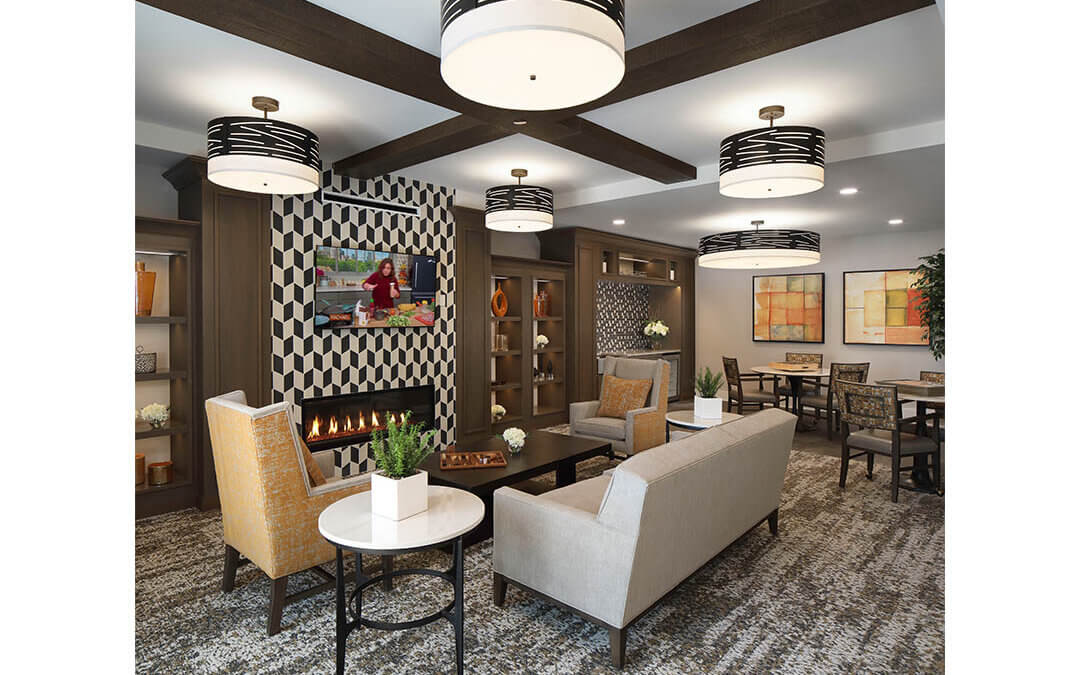
[Pictured above: CedarStone | Cedar Falls, Iowa]
As the senior living industry continues to evolve its environments, services and operations, household-style settings provide a design solution that improves daily life for residents, family and staff. The original household model concepts gained popularity in the 1990s as a paradigm shift, a stark contradiction to the traditional institutional style care settings—senior care provided in a hospital layout. There was an industry-wide call to action for culture change and the response was environments more reminiscent of the homes people were leaving behind in order to receive long-term care. The household model has experienced various interpretations over the years, some more successful in comparison to others, but all with good intentions—improving the quality of life and the level of care provided to seniors.
AG has been an active participant in this culture change, evolving care settings alongside clients and project team partners to bring enticing environments to markets across the country. Award-winning projects since the late 1990s and early 2000s underscored successful components of person-centered household design. Each iteration was about providing familiar elements of a home and recreating a residential feel at varying building scales. We shared these insights along with several case studies in a 2016 article, Home Sweet Home – The Essentials Elements of Household Design.
We are fortunate to continue to work with forward-thinking providers and developers who are always looking for ways to elevate the senior living experience. With each new client and project, questions arise as to how to create marketable and sought-after assisted living and memory care environments.
As you consider household-style settings for your next assisted living and memory care project, here are some of the key elements that guide our process in both environments—our current philosophy for creating the desirable home sweet home appeal.
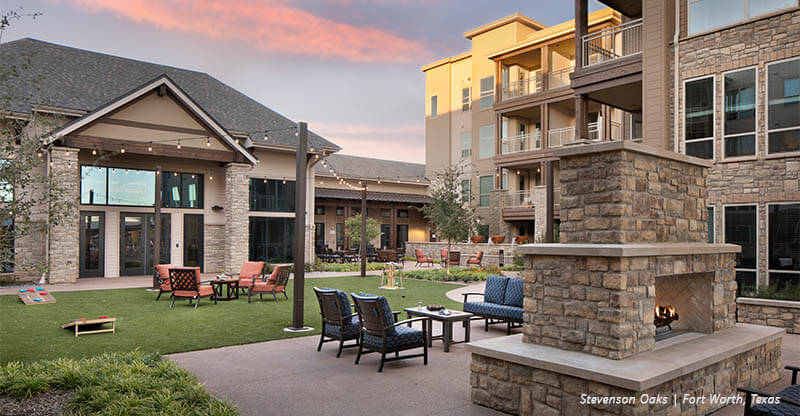
Appropriate contextual & cultural fit
The definition of “familiar” and “residential style” is both location and culturally specific. Settings should reflect the surrounding community and its history. This is especially important for memory care environments in order to provide a sense of comfort and familiarity.
Person-centered care
Being respectful of and responsive to individual resident preferences, needs and values is only part of the goal. We also use the term “Relationship-Based Care” to show that the day-to-day functioning in a senior living community is more than just taking care of the basic needs of residents. It’s about designing an operational mindset and physical environment that promotes the development of relationships between staff and residents— an understanding of each other on a personal level.
Encourage interaction
The physical environment can promote social interactions by considering the daily/weekly routines of residents, family and staff. Planning spaces as enticing vignettes provides a series of settings for meaningful experiences with family and friends. Providing comfortable areas, whether distinct rooms or informal resting points along a corridor where residents and staff can mingle encourages casual connections.
Continue to celebrate entertainment & food
While the level of care residents require may be changing, they should still be able to enjoy a vibrant lifestyle. A variety of venues that provide interesting experiences and foster social engagement continue to be important. Designing dining environments and activity areas to offer the same energy and excitement as the hospitality-inspired independent living spaces encourages vitality and provides a welcoming space to engage with visitors and family.
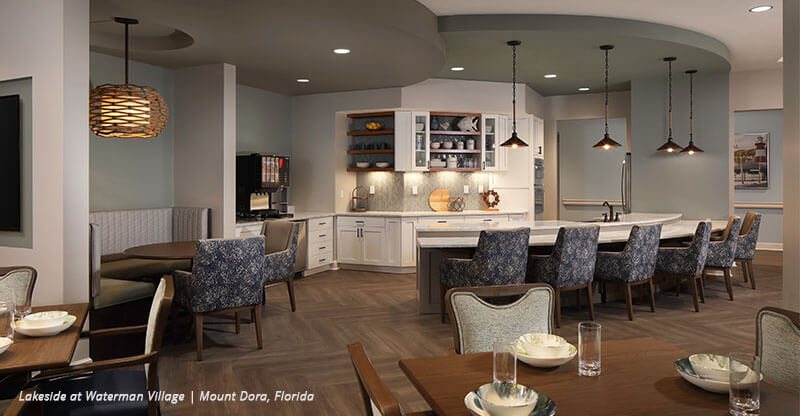
Encourage wellness through outdoor connections
Access to the natural world is healing and a vital part of our daily lives. A building design that encourages a connection with nature (biophilic design) in both the interior and exterior environment is beneficial to residents, families and staff. Designing interior spaces to maximize views of the outdoors gives residents and staff a stronger sense of location and wayfinding. It is also important to design a variety of outdoor spaces with varying levels of sun exposure, from open areas with access to full sun to partial and fully shaded options.
The introduction of biophilic design principles creates an opportunity to celebrate a health and wellness community mindset with an emphasis on the benefits of the natural world within the household. Structured and individualized options for engagement should be available in the form of dedicated classes or the ability to access spaces when desired. With the inclusion of appropriate indoor and outdoor spaces, resident movement can be safely enhanced.
Support self-care & a positive caregiving experience
The physical environment can be an effective tool to help improve the daily life of residents, staff and family members. Focusing on the abilities of residents, the physical environment should promote self-care, allowing the resident “to do for themselves” for as long as possible, and if/when care is needed it can be given and received with dignity. Examples include:
- Grab bar installation at sink fronts allows residents to steady themselves or rise from a wheelchair.
- Swing-down grab bar installation on both sides of the toilet allows additional support for sitting or standing and can be swung out of the way when staff assistance is needed.
- A fully accessible roll-in shower with appropriate grab bars continues to assist residents. Many caregivers prefer a movable shower chair instead of a wall-attached shower bench.
- Ample storage in the bathroom for hygiene supplies supports resident-assisted care and self-care.
- In memory care, residents respond to settings that promote normalized behavior. For example, a dining room that looks like a dining room makes it easier to understand what you should do in the space.
- The environment can promote exploration and engagement for both residents and family members. Visitation is often a struggle in memory care settings. A “history walk” lined with images and artifacts from the community can provide topics for discussion and spark reminiscence.
- Meaningful wandering can be achieved by purposely designing frequent destinations with both active (creating something or interacting with others) and passive (observing nature or watching something) engagement opportunities.
- “Let’s take a walk!” It is amazing how many times staff members may utilize walking to redirect and calm an agitated resident. Consideration of indoor and outdoor paths is essential to support this strategy.
Strive for an unobtrusive caregiver presence
As additional services are provided within assisted living and memory care environments an overt staffing presence in the form of highly visible staff spaces only serves to reinforce an institutional mindset and a perceived hierarchy of staff control, neither of which give a feeling of “home.” Best practices, particularly in household care settings, for staff space design leverage subtlety—integrating important spaces in discreet ways while supporting a quick staff response time when needed.
Collaboration with Operations
The physical environment influences the resident experience, but it can also promote staff efficiency and lessen the burden on caregivers. When care needs are understood, it is possible to support the staff by providing decentralized storage and service spaces, designing clear sight lines in major activity spaces and enriching the environment with technology to assist with understanding and managing resident behaviors.
It is important to collaborate closely in the design process with operations to gain an understanding of the operational style that will be pursued in the community. For example, a community focused on a family style model (do for yourself) would be drastically different in comparison to a hospitality model (done for you). Often, the operational style may be a hybrid model with a combination of both. It is important to understand which model will be followed and how that translates into the physical environment.
As assisted living and memory care environments continue to evolve, communities are offering additional services within the license to alleviate the pressure on skilled nursing environments. With this evolution, design principles become more critical to ensure a residential experience remains and staff feels valued and respected. While the principles focus on the resident it is recognized that staff well-being needs equal attention.
While we have highlighted strategies that drive our design process, there are numerous points of consideration and best practices for these specialized environments. That is what makes each collaboration and project an exciting endeavor and how we continue to evolve the household setting and elevate the senior living care experience.
Want to have a deeper conversation about your household design questions?
Contact Andrew Alden – aalden@agarch.com