
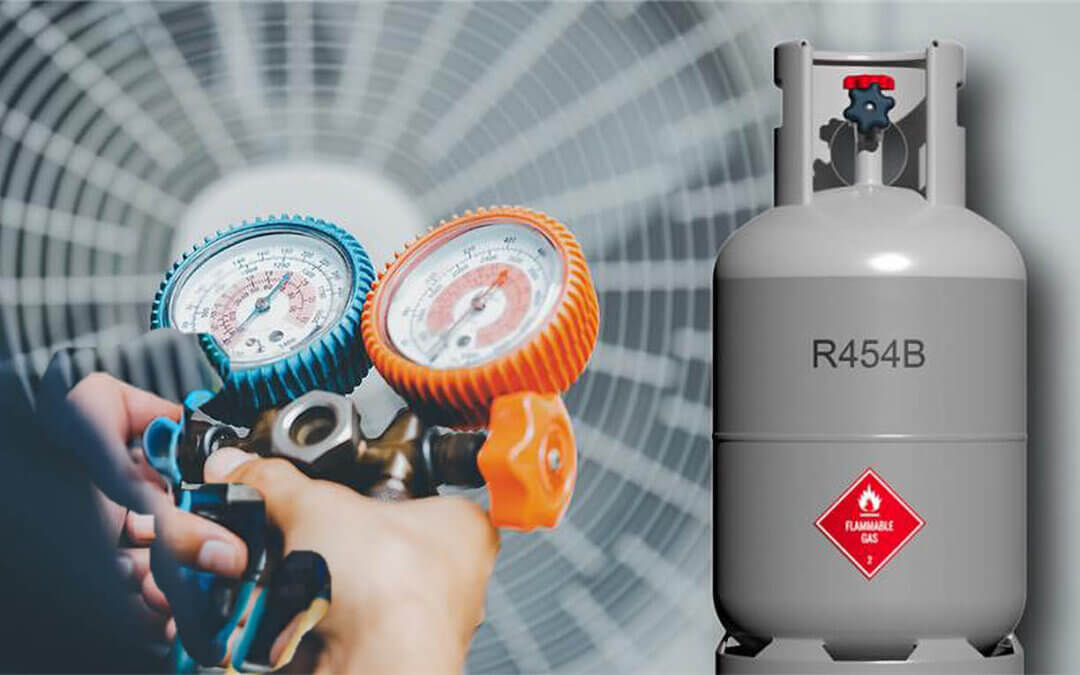
The implementation of new federal refrigerant requirements is impacting multifamily and senior living designs that have been tried and true for decades. This means air conditioning installation just got harder and more expensive.
The refrigeration cycle is confusing enough for most people. Compressors, evaporators, and the often demonized, environmentally unfriendly fluid that is refrigerant keep us cool. Increasingly, it is also being used to keep us warm when applied to heat pumps. It’s hard enough explaining how it heats a building using 50-degree outside air. Now throw in hastily written government regulations and try to design a building without spending an additional fortune or making your project look awful. Welcome to 2025 and some of the unfortunate realities you were warned about in our June 2024 Tech Talk article when the refrigerant rule changes were mentioned.
Effective January 1, 2025, the Environmental Protection Agency (EPA) prohibits the manufacture of new residential mechanical cooling equipment using the common refrigerant R-410A to curb the effects of global warming. New refrigerants have a lower Global Warming Potential (GWP); however, ASHRAE has classified them as A2L refrigerants, with the ‘L’ indicating low flammability. Prior refrigerants were non-flammable.
A2L refrigerants have a flame propagation speed of less than 10 centimeters per second. This means the flame will not continue to burn after the ignition source is removed. Regardless, the 2021 and later versions of ASHRAE and the International Mechanical Code have new requirements to protect the piping from puncture and the venting of any leaked refrigerant to the outdoors. Additionally, the code does not allow the refrigerant to pass through “two floor assemblies” without being contained within a 2-hour fire-rated shaft with either mechanical or natural venting of that shaft.
Most of our residential apartment and independent living buildings are three or four stories tall. The new regulations effect these HVAC designs where we would normally locate condensing units all at grade, or all on-roof. The “two floor assembly” limit makes the ideal design placement of equipment at grade for the lower floors and on the roof for the upper floors. Locating the equipment at grade is less costly than creating a flat roof on some buildings. In other instances where we have a flat roof building in a more urban setting, there is no room at grade to locate equipment.
To date, AG has found one manufactured, fire-rated shaft alternative product. This product is a metal duct that can be closed up and is coated with a fire retardant. It installs in place of a field-built drywall shaft. However, this system requires additional space in the mechanical closet for a metal shaft assembly. In addition, all penetrations of the refrigerant must have fire-stopping applied. Furthermore, in the event of a leak, the shaft may require ventilation in the form of a fan or a gravity pipe. Either of those vent methods comes with additional challenges and costs.
Possible alternatives to expensive shaft construction include:
1) Locate condensers both at grade and on the roof to minimize refrigerant lengths.
- This is dependent upon site constraints. Is there enough space adjacent to the building for these boxes?
- Is there enough wall space without windows or patio doors for the shoebox-sized electrical disconnects each unit requires?
- Is this going to be an eyesore to the residents or Owner?
- If possible, this is the least costly approach. The installation is similar to how it has traditionally been handled.
2) Extend refrigerant piping up the outside of the building.
- While this is a suggested method in the code commentary, it is the least visually appealing, having insulated copper tubes running up the side of the building. These may be concealed in a fake column or pilaster or even in a downspout, but the quantity and location may not fit with the architectural design.
- This approach adds the cost of the additional construction to conceal or enclose the line-sets on the exterior of the building.
3) Specify alternate heating/cooling equipment instead of split systems. Packaged units, such as the Magic-Pak/Comfort Pack, have all refrigerants internally.
- This takes us back to designs that were popular in the 1980s and 1990s when one room of the apartment had a closet in the corner at the exterior wall. This closet eliminates a window, causes furniture placement to become awkward, and requires a large louver at every apartment exterior, affecting the look of the building.
A huge grey area with some municipalities is that their codes may still be on the 2015 or 2018 versions, which do not address this classification of refrigerant at all. The Authorities Having Jurisdiction (AHJ) may not have a firm design solution. Until a new project comes to their town, some building officials have not even heard of these changes, so educating them is the first hurdle.
There is some hope that the technical people within ASHRAE may realize all of this is a huge overreaction. Rumors are that the 2027 edition of ASHRAE Standard 15, Safety Standard for Refrigeration Systems, may remove these shaft requirements. Additionally, there is a modified version ASHRAE 15.2, Safety Standard for Refrigeration Systems in Residential Applications, which removes the shaft ventilation requirement, somewhat simplifying the installation. Either way, it is recommended that developers, building Owners, HVAC engineers, architects and code officials discuss this as early as possible on projects to avoid costly delays, redesigns or construction errors.
If this topic sparks questions about your community or project, please contact me at tjluci@agarch.com